
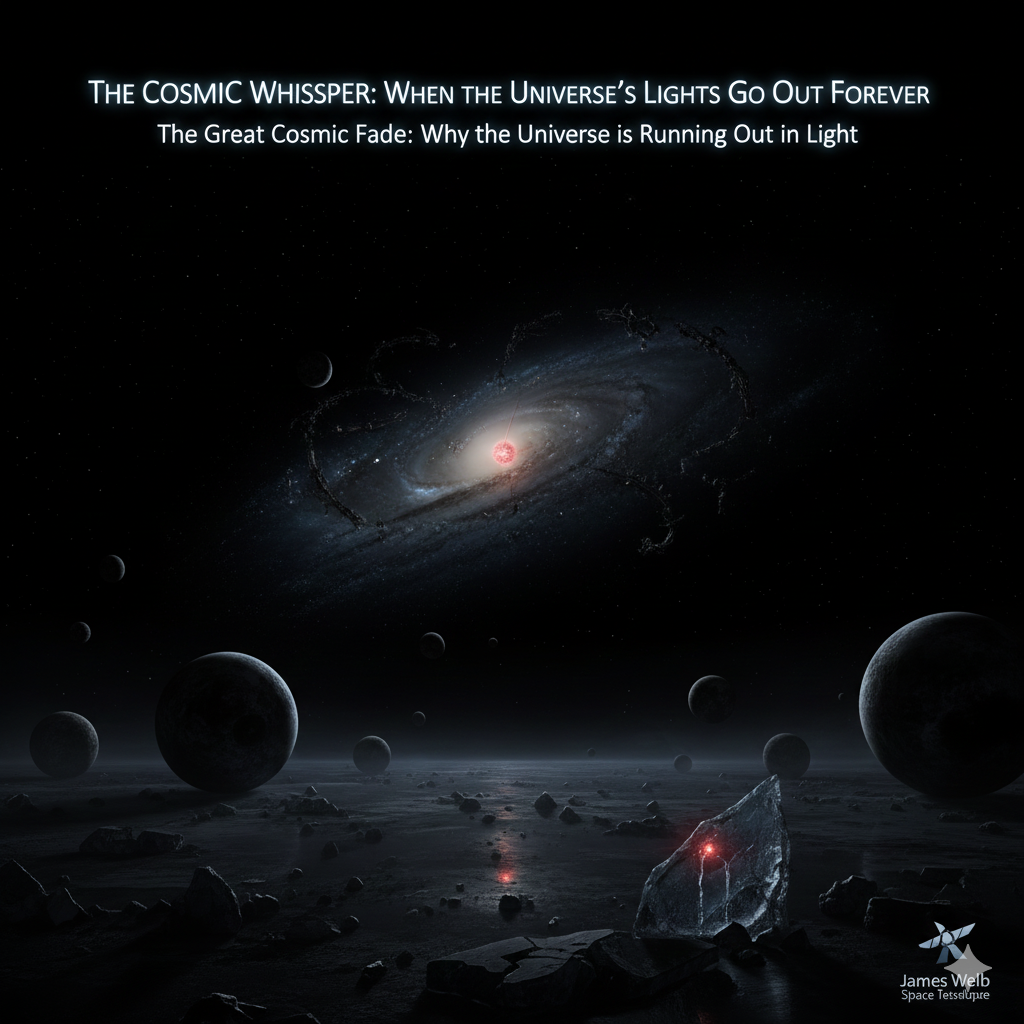
For nearly a century, we believed the universe was a place of endless rebirth. But the latest dispatches from the edge of space have brought a chilling realization: the “Great Creation” is over. We are currently living through the long, slow twilight of the cosmos.
1. The Pioneers of the Expanding Void
To understand the end, we have to look back at the people who first saw the universe moving.
- Edwin Hubble (1929): The man who changed everything. By observing distant galaxies, he proved the universe isn’t static—it’s expanding.
- The Nobel Prize Trio (1998): Saul Perlmutter, Adam Riess, and Brian Schmidt shocked the world when they discovered that the expansion isn’t slowing down; it’s accelerating. They found that a mysterious “Dark Energy” is pushing galaxies away from each other faster and faster, like an explosion that never stops.
2. The James Webb “Horror” Discovery: Star Birth is Dying
While Hubble showed us the universe is growing, the James Webb Space Telescope (JWST) is showing us it is growing barren.
In a series of recent press releases from NASA and the ESA (European Space Agency), teams like the JADES (JWST Advanced Deep Extragalactic Survey) collaboration have revealed something unexpected. They looked back 13.8 billion years to the “Cosmic Dawn” and found that while the early universe “crackled” with star formation, that fire has mostly gone out.
The Reality Check: Scientists like Professor Simon Driver (leader of the GAMA survey) have confirmed that the energy produced by galaxies today is only half of what it was 2 billion years ago. The universe has passed its peak.
3. The “Red and Dead” Galaxies
Recently, a team led by Dr. Tobias Looser and Dr. Francesco D’Eugenio from the University of Cambridge used Webb to find “quiescent” or “dead” galaxies. These are galaxies that lived fast and died young. They stopped forming stars only 700 million years after the Big Bang.
- Why is this scary? It shows that galaxies can “starve” to death. They run out of gas or have their fuel blown away by supermassive black holes.
- The Result: If galaxies stop making stars, eventually, there will be no new suns to replace the old ones.
4. The Fate of Our Sun: 13.8 Billion Years of History, 5 Billion Left
The universe was created 13.8 billion years ago, and for a long time, it was a factory of light. But the factory is closing.
- The Sun’s Decline: Our Sun is a middle-aged star. In about 5 billion years, it will run out of hydrogen, swell into a terrifying Red Giant, and eventually fade into a cold, dark “White Dwarf.”
- The Big Freeze: As galaxies drift further apart due to expansion, the light from other stars will become impossible to see.
The Final Word: A Universe on the “Sofa”
As Professor Simon Driver famously put it, the universe has basically “sat down on the sofa, pulled up a blanket, and is about to nod off for an eternal doze.” We are the lucky ones. We live in an era where there is still enough light to see the stars. Future generations of any life form, trillions of years from now, will be born into a sky of total, absolute darkness.